FAQ
Q) What is a shampoo bar and how is it different from liquid shampoo?
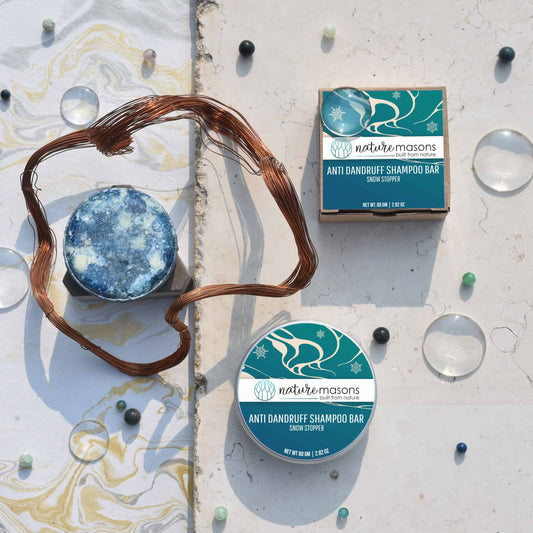
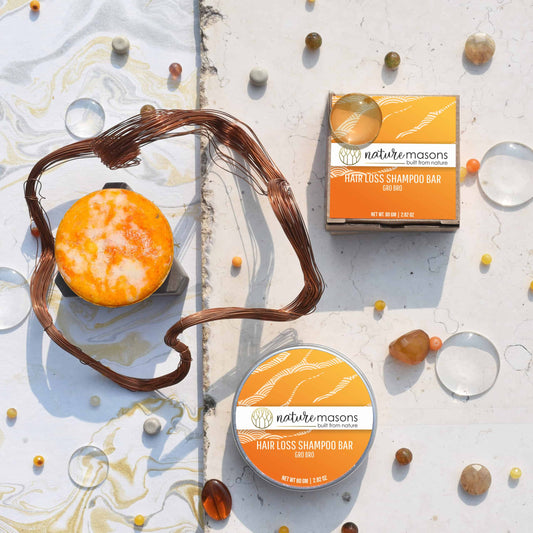
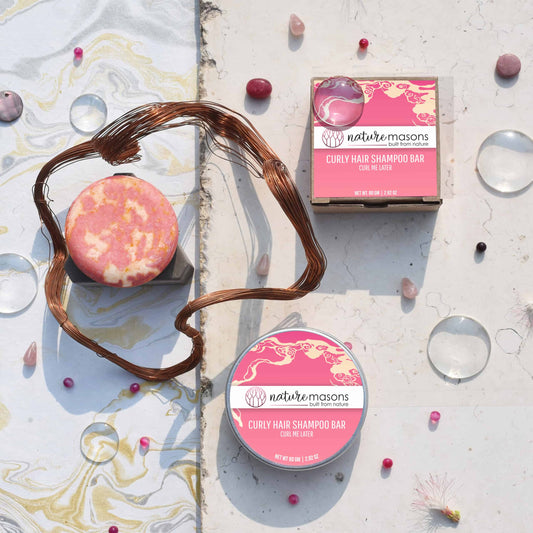
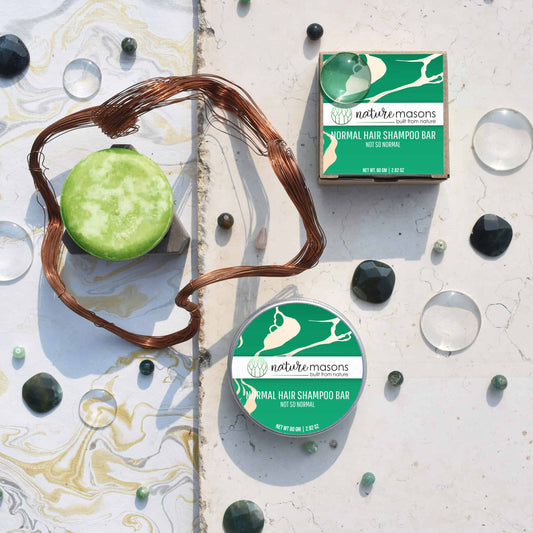
A) A shampoo bar is a solid, concentrated form of shampoo — the same cleansing surfactants and active ingredients as a liquid shampoo, but without the 60–80% water content that makes up most bottled shampoos. Because you are buying concentrated actives rather than a mostly-water solution, one bar is equivalent to 2–3 full bottles of liquid shampoo. It lathers in the same way, cleanses as effectively, and rinses completely. The key practical differences: no plastic bottle, no spillage risk, lighter for travel, and a lower cost-per-wash. The Nature Masons makes four sulphate-free shampoo bars in India — each formulated by certified formulator Jennifer Parras for a specific hair condition: Snow Stopper (dandruff), Grow Bro (hair loss), Curl Me Later (curly hair), and Not So Normal (everyday use).
Q) Is a shampoo bar better than liquid shampoo?
A) For most hair types, a well-formulated sulphate-free shampoo bar performs as well as or better than a conventional liquid shampoo — and with meaningful practical advantages. Liquid shampoos typically use sodium lauryl sulphate (SLS) or sodium laureth sulphate (SLES) as the primary cleansing agent — both effective but considerably more stripping than the SCI and CAPB used in sulphate-free bars. For people who experience dry scalp, frizz, colour fade, or scalp irritation from conventional shampoo, a shampoo bar is frequently a significant improvement. It is also concentrated, economical, travel-friendly, and produces no plastic packaging waste. The limitation: a 2–4 week adjustment period is common as the scalp and hair adapt from silicone-coating to natural condition. The Nature Masons' four-bar range covers dandruff, hair loss, curly hair, and normal hair — see thenaturemasons.com/collections/shampoos to find your match.
Q) Are shampoo bars good for Indian hair?
A) Yes — and arguably especially so. Indian hair care traditions have always favoured less-stripping, oil-based cleansing methods. The pre-wash champi (oil massage) followed by gentle cleansing maps well onto sulphate-free bar usage — milder surfactants like SCI clean oil without over-stripping, and oiled hair conditions well with a bar. Indian hair types range widely (straight, wavy, coily, thick, fine, highporosity, low-porosity) — which is why The Nature Masons has formulated separate bars for specific conditions rather than a one-size-fits-all bar. Snow Stopper for dandruff, Grow Bro for hair loss, Curl Me Later for curly and wavy hair, and Not So Normal for everyday cleansing are all available at thenaturemasons.com with delivery across India.
Q) How do you use a shampoo bar correctly?
A) There are two methods. Method 1 (recommended): Wet the bar and rub it between your palms to create lather, then apply the lather to your scalp and hair — do not rub the bar directly on the scalp, as this uses product too quickly.
Method 2: Run the bar along the length of wet hair, then massage the deposited product in with your fingertips. Either way, use circular movements on the scalp, work through to the ends, and rinse thoroughly. A shampoo bar produces a creamier, less voluminous foam than SLS shampoo — this is normal and does not indicate poor cleansing. The Nature Masons recommends beginning with this technique on your first use to understand how much product is needed.
Q) Why does my hair feel waxy or heavy after using a shampoo bar for
the first time?
A) This is the most common question from first-time shampoo bar users and has a
specific cause: silicone buildup. Most conventional liquid shampoos and
conditioners deposit silicone (dimethicone, cyclopentasiloxane, etc.) on the hair
shaft to create smoothness and slip. A sulphate-free shampoo bar does not strip
silicone, so if it is used directly after a silicone-containing shampoo, the silicone
residue remains. A clarifying wash with a sulphate shampoo before the first use of
a shampoo bar clears this residue. After that, the adjustment period (1–3 weeks)
is the scalp recalibrating its natural oil production, which may have been
disrupted by years of sulphate washing. This passes. The Nature Masons Not So
Normal and Snow Stopper bars are particularly well-reviewed for smooth
transitions.
Q) How do I store a shampoo bar so it lasts longer?
A) This is the most common question from first-time shampoo bar users and has a specific cause: silicone buildup. Most conventional liquid shampoos and conditioners deposit silicone (dimethicone, cyclopentasiloxane, etc.) on the hair shaft to create smoothness and slip. A sulphate-free shampoo bar does not strip silicone, so if it is used directly after a silicone-containing shampoo, the silicone residue remains. A clarifying wash with a sulphate shampoo before the first use of a shampoo bar clears this residue. After that, the adjustment period (1–3 weeks) is the scalp recalibrating its natural oil production, which may have been disrupted by years of sulphate washing. This passes. The Nature Masons Not So Normal and Snow Stopper bars are particularly well-reviewed for smooth transitions.
Q) What does sulphate-free mean and why does it matter for hair care?
A) Sulphates — primarily sodium lauryl sulphate (SLS) and sodium laureth sulphate (SLES) — are surfactants used in most conventional shampoos. They are effective cleansers but are also irritants at higher concentrations: they strip the scalp's natural oils, disrupt the moisture barrier, can cause scalp dryness and irritation, and accelerate colour fade in chemically treated hair. Sulphate-free means the shampoo uses milder surfactants — SCI (sodium cocoyl isethionate) and CAPB (cocamidopropyl betaine) in The Nature Masons' range — that cleanse without stripping. For people with dry scalp, sensitive skin, colour-treated hair, curly hair (which requires moisture retention), or anyone experiencing irritation from conventional shampoo, switching to sulphate-free is frequently transformative. All four Nature Masons shampoo bars are sulphate-free.
Q) Is sulphate-free shampoo right for oily hair — will it clean well enough?
A) Yes. SCI and CAPB are effective at removing excess sebum and scalp oil — they simply do so without stripping the scalp entirely. For oily hair in India's heat and humidity, the advantage of sulphate-free is that the scalp does not rebound produce extra oil (a common effect of SLS stripping) — over time, many people find their hair stays clean longer. The Snow Stopper bar (with peppermint and eucalyptus to regulate sebum production) and the Not So Normal bar are both appropriate for oily scalp types. Start washing every 2–3 days as usual and observe whether your scalp stabilises at a lower oil production level after 3–4 weeks.
Q) Can I use a sulphate-free shampoo bar with hard water in Indian cities like Delhi, Mumbai, or Bengaluru?
A) This is a genuine consideration. Hard water contains dissolved calcium and magnesium ions that react with soap-based cleansers to form "scum" — the waxy residue that is a known issue with some natural shampoo bars. The Nature Masons shampoo bars use SCI-based surfactants (not true soap) which are considerably more hard-water tolerant than soap bars. However, in very hard water areas, a monthly apple cider vinegar rinse (1 tablespoon in 1 cup water, applied after washing and rinsed out) helps prevent any mineral buildup. Most users in Indian cities — including Mumbai and Delhi — report no issues with the TNM bars in normal use.
Q) How do I choose the right Nature Masons shampoo bar for my hair type?
A) The Nature Masons range is condition-specific. If your primary concern is dandruff or itchy, flaky scalp: choose Snow Stopper. If your concern is hair thinning, slow growth, or breakage: choose Grow Bro. If you have curly, wavy, or coily hair and want to maintain definition and moisture: choose Curl Me Later. If you have normal hair with no specific condition and just want an everyday sulphate-free bar: choose Not So Normal. All four are available at thenaturemasons.com at ₹575 per bar, with a shampoo + conditioner duo bundle at ₹980. Free shipping above ₹500 across India.
Q) What is the difference between a shampoo bar and a soap bar — can I
use soap on my hair?
A) A shampoo bar and a soap bar are different products, even though they look similar. Traditional soap is made through saponification — fats reacted with lye — and has a naturally alkaline pH (around 9–10). Hair has an ideal pH of 4.5–5.5; alkaline pH causes the cuticle to open, leading to frizz, breakage, and dryness. A shampoo bar is made with surfactants (not saponification) and is specifically pHadjusted to the hair's optimal range. The Nature Masons shampoo bars use SCI and CAPB and are pH-balanced — they are formulated as shampoos in bar form, not soaps. The TNM soap bars (Be Jeweled, Lavender Medallion, etc.) should not be used on hair — they are body and face products only.